
How to Make Money Online in 2026: A Complete Guide to Digital Skills, Online Business, and Selling Digital Products
The internet has created opportunities for people to learn valuable skills, provide services to businesses, sell digital products, and reach customers beyond their immediate locations.
Today, you do not necessarily need to own a physical shop, rent an office, or employ a large team to start an online business. With a smartphone or computer, an internet connection, the right skills, and a practical plan, you can begin building a digital business from wherever you are.
However, there is an important truth that every beginner should understand: making money online is not automatic, and there is no guaranteed shortcut to success.
Many people spend months searching for ways to earn online without developing a marketable skill, identifying a customer problem, or learning how to sell a solution. Others purchase courses and digital products but never put the information into practice.
The difference between simply browsing the internet and building an online business often comes down to having a clear strategy and taking consistent action.
In this comprehensive guide, we will explore practical ways to make money online in 2026, the digital skills worth learning, how to create and sell digital products, how to attract customers, and how to build a sustainable online business.
Whether you are a student, an entrepreneur, a small business owner, a freelancer, or someone looking for additional income, this guide will help you understand where to begin.
1. Understand How Making Money Online Really Works
Before choosing an online business model, it is important to understand the basic principle behind earning money.
Online income comes from delivering something valuable that people are willing to pay for.
That value may come from your knowledge, technical skills, creativity, products, or ability to help customers solve problems.
For example:
- A business owner needs a website to attract customers.
- A small company needs a professional logo to establish its identity.
- A student needs a study guide to prepare for an examination.
- An entrepreneur needs an ebook explaining how to launch a particular type of business.
- A local shop needs help displaying its products online.
- A professional needs assistance managing digital content or improving an existing website.
Each situation represents a potential business opportunity.
Instead of asking only, “How can I make money online?” ask yourself three more useful questions:
- What problem can I solve?
- Who experiences this problem?
- What solution can I offer that people are willing to pay for?
Your answers will help you identify a suitable online business model.
For instance, if you understand website design, you can offer website creation services. If you have specialised knowledge about a subject, you might turn that knowledge into an educational ebook. If you enjoy writing, you could provide content-writing services to businesses.
You do not need to do everything at once. Start with one clear opportunity, learn how to deliver it effectively, and improve your business as you gain experience.
2. Learn a Digital Skill That People Need
One of the most practical ways to enter the online economy is by developing a digital skill.
A digital skill is an ability that allows you to create, manage, improve, or promote something using digital technology.
Businesses increasingly use websites, social media, online stores, digital advertisements, and other internet-based tools to reach customers. This creates opportunities for people who can help them use those tools effectively.
Here are some digital skills you can consider learning.
A. Website Design
Website design involves creating websites that present information, products, and services in a professional and accessible way.
Businesses use websites to explain what they offer, establish credibility, receive enquiries, display portfolios, and generate sales.
You can learn to create websites for:
- Small businesses.
- Schools and educational organisations.
- Churches and nonprofit organisations.
- Restaurants and food businesses.
- Consultants and professionals.
- Online stores.
- Personal brands.
- Service providers.
You can begin by learning the fundamentals of website structure, layout, typography, colours, mobile responsiveness, and user experience.
You can then practise building simple websites using tools such as WordPress.
Once you have developed the necessary skills, create sample projects that demonstrate what you can do. These projects can become part of your portfolio when approaching potential clients.
How you can earn: Charge clients for website creation, redesign, maintenance, landing pages, or troubleshooting, depending on your ability and the agreed scope of work.
B. WordPress Website Management
WordPress is a widely used platform for creating and managing websites.
Learning WordPress can open several service opportunities beyond building websites from scratch.
You could specialise in:
- Installing and configuring WordPress.
- Customising themes.
- Creating and editing pages.
- Setting up navigation menus.
- Improving mobile layouts.
- Troubleshooting common website problems.
- Updating website content.
- Installing and configuring suitable plugins.
- Maintaining backups and security.
- Improving basic search engine optimisation.
Some business owners already have websites but struggle to maintain them. Others have websites that look outdated or contain technical problems.
These business owners may need someone who can make their websites easier to use and maintain.
Start by practising on a test website. Learn how to make changes safely, understand how backups work, and test your work before offering services to paying clients.
C. Graphic Design
Graphic design involves creating visual materials that communicate information and strengthen a brand’s identity.
Businesses need visual content for their websites, advertisements, social media accounts, product packaging, and promotional campaigns.
Possible services include:
- Logo design.
- Social media graphics.
- Business flyers.
- Advertising banners.
- Ebook covers.
- Product catalogues.
- Business presentations.
- Website graphics.
- Promotional posters.
You can begin with accessible design tools and gradually develop your understanding of composition, colour, typography, spacing, and visual hierarchy.
Build a portfolio containing several examples of your work. Make it clear what problem each design solves and how the design supports the client’s communication goals.
Important: Do not simply copy another designer’s work. Practise creating original designs and use fonts, photographs, illustrations, and other assets in accordance with their licences.
D. Content Writing
Content writing involves creating useful written material for websites, businesses, publications, and digital products.
Examples include:
- Blog articles.
- Website service descriptions.
- Product descriptions.
- Educational guides.
- Email newsletters.
- Social media captions.
- Frequently asked questions.
- Landing-page copy.
Businesses need content that explains their offers, answers customer questions, and encourages appropriate action.
To develop this skill, practise writing clearly and organising information logically.
Learn basic search engine optimisation, commonly called SEO, so you understand how to structure content around topics people search for online.
A strong writer does more than produce words. They understand the audience, the purpose of the content, and the action the reader should take.
E. Digital Marketing
Digital marketing involves using online channels to reach potential customers and encourage them to take useful actions.
These actions might include visiting a website, requesting a quotation, subscribing to a newsletter, downloading a resource, or purchasing a product.
Digital marketing can include:
- Search engine optimisation.
- Social media marketing.
- Email marketing.
- Paid advertising.
- Content marketing.
- Landing-page optimisation.
- Customer relationship management.
- Conversion measurement.
You do not need to master every aspect of digital marketing immediately.
Choose one area, learn the fundamentals, practise with small projects, and measure your results.
For example, you could learn how to improve a small business website’s service pages so that visitors understand the offer and know how to contact the business.
How Do You Choose the Right Skill?
Consider these three factors:
Your interest: Choose something you are willing to practise consistently.
Market demand: Research whether people or businesses are already paying for the service.
Your available resources: Consider the equipment, internet access, software, and learning time required.
Do not choose a skill only because someone claims it can make you rich quickly. Choose one that you can realistically learn, practise, and deliver to a customer.
3. Start Freelancing and Offer Digital Services
Freelancing is a business model in which you provide services to clients, usually on a project basis or under an agreed contract.
It can be a practical starting point because you may be able to earn from a skill without first creating your own physical product.
For example, a person who understands WordPress can offer website editing services. Someone who can create attractive promotional graphics can work with businesses that need advertising materials.
Step 1: Choose One Specific Service
Avoid presenting yourself as someone who does everything when you are just starting.
Instead, choose a service you can deliver competently.
For example:
- I design professional WordPress websites for small businesses.
- I create promotional graphics for businesses and online sellers.
- I help business owners update and manage their WordPress websites.
- I create landing pages for digital products.
- I design professional ebook covers and digital product graphics.
A specific offer makes it easier for potential customers to understand what you do.
Step 2: Identify Your Ideal Customer
Think about the people or organisations most likely to need your service.
If you design business websites, your potential customers may include consultants, retailers, educational organisations, restaurants, and service providers.
If you create ebook covers, your customers may include authors, coaches, online educators, and digital product sellers.
Understanding your audience helps you decide where to advertise and what message to use.
Step 3: Create a Portfolio
A portfolio demonstrates your ability to deliver the service.
If you have not worked with paying clients yet, create sample projects.
For example, you could build a demonstration website for a fictional restaurant or design a sample product catalogue for an imaginary shop.
Clearly identify these as demonstration projects rather than pretending they were paid client assignments.
Your portfolio should show the quality of your work and the kinds of problems you can solve.
Step 4: Set Clear Prices
Your pricing should reflect your skill level, the complexity of the work, the time involved, and the value delivered.
When quoting for a project, explain what is included.
For example, a website-design quotation might specify:
- The number of pages.
- The design and setup work.
- Mobile responsiveness.
- Contact-form configuration.
- Basic SEO setup.
- The number of revisions.
- The expected delivery timeline.
- Any additional costs for hosting, domain registration, premium themes, or third-party services.
Do not promise unlimited revisions or accept an unclear project scope.
A written agreement helps both parties understand their responsibilities.
Step 5: Find Potential Clients
You can reach potential clients through several channels:
- WhatsApp Business.
- Facebook business groups.
- Instagram.
- LinkedIn.
- Freelance marketplaces.
- Local business networks.
- Your own website.
- Referrals from satisfied customers.
The key is to approach people professionally.
Instead of sending generic messages to hundreds of businesses, identify companies that may genuinely benefit from your service.
Explain what you noticed, how you can help, and what the next step would be.
Avoid making unrealistic promises about sales, search rankings, or guaranteed results.
Step 6: Deliver Excellent Work
Your reputation is one of your most valuable business assets.
Complete projects according to the agreed scope, communicate progress, respect deadlines, and explain how clients can use the work you deliver.
After a successful project, ask the client for honest feedback or permission to include the work in your portfolio.
Over time, good delivery and clear communication can help you earn repeat business and referrals.
4. Create and Sell Digital Products
Freelancing allows you to earn by providing services to clients. Digital products offer another opportunity: creating a resource that customers can purchase and access electronically.
A digital product is an item delivered digitally rather than as a physical product.
Examples include:
- Ebooks.
- PDF guides.
- Online courses.
- Templates.
- Checklists.
- Digital planners.
- Educational workbooks.
- Website templates.
- Design resources.
- Spreadsheet tools.
- Downloadable business documents.
Digital products can be attractive because a well-prepared product can be sold repeatedly without recreating the entire product for every customer.
However, this does not mean digital products generate automatic income. You still need to develop something useful, communicate its value, attract potential customers, provide good customer support, and improve your marketing.
Why Do People Buy Digital Products?
People often purchase digital products because they want to save time, learn something, follow a process, or solve a particular problem.
For example:
- A small business owner may purchase a guide to help establish a professional online presence.
- A beginner may purchase a workbook that explains how to organise a new business idea.
- A freelancer may buy a proposal template to prepare client quotations more efficiently.
- A website owner may purchase a checklist for preparing website content before launch.
The more clearly a product solves a real problem, the easier it becomes to explain why someone might want it.
Step 1: Identify a Specific Problem
Do not begin by creating an ebook simply because ebooks are easy to distribute.
Start with a problem your intended audience experiences.
Consider these examples:
Small business owners
Problem: Difficulty attracting customers online.
Possible product: Small Business Digital Growth Guide.
New freelancers
Problem: Uncertainty about finding clients.
Possible product: Freelancing Starter Workbook.
Beginner website owners
Problem: Difficulty organising website content.
Possible product: Website Planning Checklist.
Aspiring digital sellers
Problem: Confusion about creating and marketing digital products.
Possible product: Digital Product Launch Guide.
Content creators
Problem: Difficulty planning consistent content.
Possible product: Social Media Content Calendar.
These are starting points, not proof of market demand. Before investing substantial time in creating a product, research the topic, examine existing solutions, and speak to potential customers.
Step 2: Research Your Audience
Find out what people are already asking about the problem.
You can research:
- Google search suggestions.
- Questions in relevant online communities.
- Comments on educational videos.
- Frequently asked questions in your industry.
- Reviews of competing products.
- Discussions with potential customers.
Look for recurring questions and frustrations.
For example, if people repeatedly ask how to start selling digital products, a guide that explains product creation, pricing, sales pages, payments, and promotion may be useful.
Your aim is not to copy existing products. It is to understand what people need and create an original, useful resource.
Step 3: Create a Clear Product Outline
Organise the product into sections that take the reader from the problem to a practical solution.
For example, an ebook about starting an online business might include:
- Understanding online business models.
- Identifying a marketable skill.
- Choosing a target audience.
- Researching customer needs.
- Creating a service or digital product.
- Setting prices.
- Establishing an online presence.
- Promoting the offer.
- Handling customer enquiries.
- Measuring results and improving the business.
Each section should explain the subject clearly and give readers practical steps to follow.
Avoid filling an ebook with unnecessary repetition just to increase its page count.
A concise, useful guide can be more valuable than a long document that leaves readers confused.
Step 4: Prepare a Professional Ebook
Your ebook should be easy to read on a phone, tablet, or computer.
Pay attention to:
- A clear title and subtitle.
- A professional cover.
- Consistent headings.
- Readable fonts.
- Appropriate spacing.
- Useful examples.
- Practical checklists.
- A table of contents.
- Correct spelling and grammar.
- Working links where relevant.
- A helpful conclusion.
Save the finished document as a PDF if that format suits your product.
Before publishing, open the PDF on a mobile device and check that the pages, headings, links, and images display properly.
Step 5: Choose a Platform to Sell Your Product
You need a reliable way to present your product and collect payments.
Depending on your audience and business needs, you could use a digital product marketplace or payment platform.
For example, Selar provides tools for selling digital products.
Visit Selar at:
When setting up your product, pay attention to:
- Product title.
- Product description.
- Cover image.
- Price and supported currency.
- Payment options.
- Delivery method.
- Refund policy.
- Customer support information.
Make sure your product description explains what customers will receive and what they should realistically expect to learn.
Step 6: Price the Product Thoughtfully
There is no universal price that guarantees digital product sales.
Your price should reflect the product’s usefulness, depth, target audience, competing alternatives, and your business objectives.
Research comparable products and consider asking potential customers what they need before finalising your price.
A lower price may make a product accessible to more people, but it does not automatically make it more attractive. A higher price also requires a clear explanation of the value provided.
Most importantly, do not promise that buying an ebook will guarantee income, employment, or business success.
Explain what the product teaches and what effort readers will need to apply.
Step 7: Promote the Product
Publishing an ebook is only one part of the process.
You must also help the right people discover it.
Promotion methods include:
- Writing useful blog posts.
- Publishing educational social media content.
- Sharing relevant tips on WhatsApp.
- Creating short demonstration videos.
- Building an email list with appropriate consent.
- Collaborating with relevant creators.
- Running carefully measured advertising campaigns.
- Offering a useful free resource related to the product.
A strong promotion strategy starts with education.
For example, if your ebook teaches beginners how to build an online income strategy, publish articles explaining how to choose a digital skill, create a portfolio, or develop a digital product.
These articles can attract people who are already interested in the subject.
You can then introduce your ebook as a resource that brings the lessons together into a structured guide.
5. Build a Professional Website for Your Online Business
A website can become a central part of your digital business because it gives potential customers a dedicated place to learn about your services, products, experience, and contact information.
Social media is useful for attracting attention, but a professional website can help you organise your business information and guide visitors towards a specific action.
For example, a website can help you:
- Present your services.
- Display your portfolio.
- Publish educational articles.
- Collect customer enquiries.
- Showcase digital products.
- Build search engine visibility.
- Explain your business policies.
- Direct customers to a purchase page.
What Should a Business Website Include?
A professional website should make it easy for visitors to understand what you offer and how to take the next step.
Consider the following essential pages.
Home page: Introduce your business, explain your main offer, and guide visitors towards important pages.
About page: Explain your background, values, expertise, and approach to serving customers.
Services page: Describe each service, the problems it solves, and how customers can request a quotation.
Products page: Present your digital products or other offers with clear descriptions and purchase links.
Blog: Publish useful articles that answer customer questions and demonstrate your knowledge.
Contact page: Provide appropriate contact methods, such as an email address, enquiry form, or business WhatsApp link.
Privacy policy: Explain how personal information is collected and handled where applicable.
Other pages may be necessary depending on your business model, payment arrangements, and legal obligations.
Make Your Website Mobile-Friendly
Many people browse websites using smartphones.
If your website is difficult to read on a small screen, visitors may struggle to find information or complete a purchase.
Check that:
- Text is readable without excessive zooming.
- Buttons are easy to tap.
- Navigation menus work properly.
- Images fit the screen.
- Forms are easy to complete.
- Important information is not hidden.
- Pages load reasonably quickly.
Test your website on a real mobile device rather than assuming that a desktop preview is sufficient.
Create Clear Calls to Action
A call to action, or CTA, tells visitors what to do next.
Examples include:
- Request a Website Design Quote.
- Explore Our Services.
- Download the Free Guide.
- Buy the Ebook.
- Contact Us on WhatsApp.
- Read the Latest Articles.
Avoid placing too many competing calls to action in one section.
Choose the action that best matches the visitor’s needs and the purpose of the page.
For example, a service page may focus on receiving enquiries, while a digital product page should make the purchase process clear.
How Richems Digital Can Help
At Richems Digital, the focus is on helping individuals and businesses establish and improve their digital presence.
Depending on your project requirements, services can include:
- Website design.
- WordPress website design.
- WordPress editing and troubleshooting.
- Landing-page design.
- Logo design.
- Icon design.
- T-shirt design.
- Promotional banner design.
A well-planned website can support these services by presenting your business professionally and helping prospective customers understand what you can offer them.
If your business needs a new website or improvements to an existing one, consider making professional web design part of your growth strategy.
6. Use Social Media to Attract Potential Customers
Social media can help you reach people who may be interested in your services or products.
However, simply creating an account and posting occasionally is unlikely to produce consistent results without a clear strategy.
The objective should be to attract the right audience, provide useful information, build trust, and make it easy for interested people to take the next step.
WhatsApp Business
WhatsApp Business can help small businesses communicate with customers and present selected products or services.
Visit the official website for more information:
“`htmlUseful practices include:
- Complete your business profile.
- Use a clear business description.
- Add relevant products or services to your catalogue where available.
- Use professional product images.
- Provide accurate descriptions and prices.
- Respond to enquiries promptly.
- Use labels to organise conversations.
- Obtain appropriate permission before sending promotional messages.
For a digital product, your catalogue entry could explain the title, intended audience, key lessons, price, and purchase method.
Avoid sending repetitive unsolicited advertisements. Respect people’s preferences and applicable messaging rules.
Facebook can be useful for building a business presence, sharing educational content, participating in relevant communities, and advertising products.
Create posts that help people understand the problem you solve.
For example, if you sell an ebook about starting an online business, you could publish an educational post explaining three common mistakes beginners make when choosing an online business model.
At the end, invite interested readers to learn more about your guide.
Your post should deliver value even before the reader clicks the purchase link.
Instagram offers opportunities to promote digital products and services through images, short videos, carousels, Stories, and other available formats.
You could publish:
- Website redesign examples.
- Before-and-after design demonstrations.
- Tips for improving business websites.
- Short educational videos.
- Ebook previews.
- Customer testimonials, with permission.
- Answers to common customer questions.
Use readable graphics and captions that explain the value of your offer.
Include a clear next step, such as visiting your website or following the product link in your profile where available.
Follow a Simple Content Strategy
A practical content strategy can include four types of posts.
Educational content: Teach your audience something useful.
Problem-awareness content: Explain a common challenge your audience experiences.
Demonstration content: Show how a service or product works.
Promotional content: Explain your offer and invite people to purchase or enquire.
You do not need to publish a sales advertisement in every post.
A balanced approach helps you build trust while still communicating that your business has products and services available.
7. Learn Search Engine Optimisation to Attract Visitors
Search engine optimisation, or SEO, is the process of improving a website so that search engines can discover, understand, and present its pages to relevant users.
For a business website, SEO can support long-term visibility when people search for related services, products, or information.
For example, someone may search for:
- Website designer in Nigeria.
- How to create a WordPress website.
- Cost of website design in Nigeria.
- How to sell ebooks online.
- Digital marketing tips for small businesses.
If your website publishes genuinely helpful content related to these topics, it may become eligible to appear in relevant search results.
However, SEO does not guarantee that a particular article will rank first or receive a specific amount of traffic.
Step 1: Research Search Intent
Search intent means understanding what a person hopes to accomplish when they enter a query into a search engine.
Someone searching for “What is WordPress?” may want an explanation.
Someone searching for “WordPress website designer in Lagos” may be looking for a service provider.
Your content should match the intent behind the search.
If the user wants to learn, provide a helpful explanation. If the user wants to hire a service provider, make your services, portfolio, location, and contact information easy to find.
Step 2: Use a Clear Article Structure
Organise your blog posts with:
- One clear main heading.
- Descriptive section headings.
- Short, readable paragraphs.
- Lists where they improve clarity.
- Relevant examples.
- Helpful internal links.
- Appropriate external references.
This structure makes the article easier for people to read and helps search engines understand the content.
Step 3: Choose a Relevant Focus Keyphrase
A focus keyphrase describes the main search phrase your article targets.
For this article, the suggested keyphrase is:
How to make money online in 2026
Include the phrase naturally in appropriate places, such as the title, introduction, or a relevant heading.
Do not repeat it unnaturally throughout the article simply to increase keyword frequency.
Related terms can help you cover the subject comprehensively, but the content should remain natural and useful.
Step 4: Write a Helpful Meta Description
A meta description is a short summary that may appear beneath a page title in search results.
For this article, you could use:
“Discover how to make money online in 2026 using digital skills, freelancing, ebooks, websites, and online marketing. Learn practical steps to start and grow.”
The description should accurately reflect the article and give readers a reason to visit.
Search engines may choose to display a different snippet depending on the query.
Step 5: Use Appropriate Images
Images can make educational content more engaging and easier to understand.
Use images that relate directly to the article.
For example, an article about digital products could include an original illustration showing an ebook, an online storefront, and a customer browsing on a smartphone.
Optimise image file sizes and provide descriptive alternative text for meaningful images.
Use original images or assets that you have permission to publish.
Step 6: Connect Related Articles
Internal links connect one page on your website to another page on the same website.
For example, this article could link to related Richems Digital posts about:
- Website design costs in Nigeria.
- Choosing WordPress for a business website.
- Website design mistakes that drive customers away.
- Creating a professional business website.
- Website versus social media for business growth.
These links help readers discover more relevant information and make your website easier to navigate.
Step 7: Monitor Your Results
Google Search Console can help website owners understand how their pages perform in Google Search.
Visit:
“`htmlReview available data about impressions, clicks, search queries, and indexing.
Use the information to identify articles that need better explanations, more useful examples, clearer titles, or stronger internal links.
SEO is a continuing process of publishing helpful content, understanding your audience, and improving your website.
8. Build a Simple Sales Funnel for Your Digital Products
A sales funnel describes the stages a potential customer may pass through before purchasing a product or service.
For a digital product business, the process might look like this:
Helpful content → Interested visitor → Product information → Purchase → Product delivery → Customer feedback
Let’s examine each stage.
Stage 1: Attract the Right Audience
Publish content that addresses a problem your intended customers are already trying to solve.
For example, if you sell a guide to building an online business, you could publish articles about choosing a digital skill, finding potential clients, or creating an ebook.
The aim is to attract people who have a genuine interest in the subject.
Stage 2: Educate the Visitor
Give visitors enough useful information to understand their problem and possible solutions.
Your article should answer questions rather than simply repeat promotional claims.
When readers receive value from your content, they have a reason to explore other resources you provide.
Stage 3: Introduce Your Product
Explain how your product relates to the problem.
Describe what the buyer receives, the topics covered, and the intended audience.
For example, an ebook about online income might provide a structured introduction to digital services, product creation, and online promotion.
Explain its contents accurately. Do not imply that reading the ebook guarantees earnings.
Stage 4: Make Purchasing Easy
Your product page should answer common questions before the customer reaches checkout.
Include:
- A clear product title.
- A concise explanation of the problem addressed.
- The intended audience.
- Key topics or features.
- What the customer receives.
- The price.
- The payment and delivery process.
- Relevant policies and support information.
Ensure that the purchase link works and that the page is easy to use on mobile devices.
Stage 5: Support the Customer After Purchase
Customer service continues after payment.
Provide clear instructions for accessing the product and explain how buyers can contact you if they experience difficulties.
Invite honest feedback when appropriate.
Use feedback to improve the product, clarify confusing instructions, and identify topics your audience would like you to cover in future resources.
A good customer experience can support trust and encourage repeat purchases.
9. Promote Your Digital Product Without Wasting Money
Many beginners believe they must spend heavily on advertisements before they can make their first sale.
That is not necessarily true.
You can begin by using organic methods to understand your audience and test your message.
Organic promotion generally involves reaching people without paying for each advertisement placement. Examples include blog posts, relevant social media content, referrals, and community participation.
Paid advertising can be useful, but it introduces additional costs and requires careful measurement.
Start With Organic Promotion
Consider this practical approach.
First, publish an educational blog post.
Choose a topic closely related to your product and explain it thoroughly.
Second, repurpose the article into smaller pieces of content.
Turn the main lessons into short social media posts, a carousel, a short video, or a WhatsApp status series.
Third, connect the content to your offer.
Explain that readers who want a more structured resource can explore your digital product.
Fourth, observe the response.
Track meaningful actions such as website visits, product-page visits, enquiries, and purchases where the relevant data is available.
Fifth, improve your message.
If people visit your page but do not purchase, investigate possible problems. The offer may be unclear, the audience may be unsuitable, or the product page may not answer important questions.
Do not assume that every unsuccessful promotion means the product itself is bad.
When Should You Use Paid Advertising?
Paid advertising may be appropriate once you have a clear offer, a working purchase process, and a way to measure results.
Before spending money, check that:
- The product page accurately describes the product.
- The checkout process works.
- The product is suitable for the intended audience.
- The advertising creative communicates the offer clearly.
- Your budget is affordable to lose during testing.
- You can measure purchases or other meaningful outcomes.
Start with a controlled test rather than committing a large amount immediately.
For example, you might test different advertising messages to understand which attracts the most relevant visitors.
Evaluate actual sales and costs rather than relying only on likes, impressions, or comments.
Important: No advertising strategy can guarantee sales. Results depend on the offer, audience, competition, pricing, creative quality, customer experience, and other factors.
10. Avoid Common Online Business Mistakes
The internet offers opportunities, but beginners can lose time and money by approaching online business without a clear plan.
Here are common mistakes to avoid.
Mistake 1: Trying Too Many Business Models at Once
You might be tempted to start freelancing, launch an ebook, create an online store, become a content creator, and learn advertising simultaneously.
The problem is that each activity requires attention.
Choose one primary income model and develop it until you understand the process.
You can add other models later when your skills, resources, and experience allow.
Mistake 2: Waiting Until Everything Is Perfect
Professional presentation matters, but endless preparation can prevent you from testing whether people actually want your offer.
Create a useful first version, test it with an appropriate audience, collect feedback, and improve it.
Your first website or digital product does not need every possible feature.
It needs to solve a clear problem and provide a good customer experience.
Mistake 3: Expecting Immediate Income
Building an online business can take time.
You may need to learn a skill, create a portfolio, identify customers, improve your offer, and develop trust before generating consistent income.
Set realistic milestones rather than depending on a specific amount of money arriving by a particular date.
Mistake 4: Copying Other People’s Products
Copying another person’s ebook, design, website content, or branding can create legal and reputational problems.
Study competing products to understand their audience and positioning, but create your own original work.
Respect copyright, trademarks, licences, and platform policies.
Mistake 5: Ignoring Customer Needs
A product can look attractive and still fail to solve the problem customers care about.
Research your audience before investing heavily in development.
Ask potential customers what they struggle with, what they have already tried, and what they would find useful.
Use their responses to improve your offer.
Mistake 6: Spending on Advertising Without a Plan
Advertising can become expensive when you do not know which audience you are targeting or what result you are trying to achieve.
Establish a budget, test your message, and track meaningful results.
Do not increase spending simply because an advertisement receives many likes.
Mistake 7: Believing Every Online Income Promise
Be cautious about offers that promise guaranteed earnings, effortless wealth, or unusually high returns with little work.
Before paying for a course, tool, or business opportunity, investigate what is actually included, the provider’s credibility, the refund terms, and whether the claims are realistic.
A sustainable online business is built by creating value, earning trust, and improving your ability to serve customers.
11. A Practical 30-Day Plan to Start Your Online Business
If you are new to online business, a simple schedule can help you turn information into action.
The following plan assumes you can dedicate some time each day. Adjust the workload to suit your circumstances.
Days 1–7: Choose Your Direction
Your first week should focus on deciding what you want to offer.
Day 1: List your existing skills, interests, and available resources.
Day 2: Research digital services or products that people already purchase.
Day 3: Select one business model to explore.
Day 4: Identify a specific target audience.
Day 5: Research the audience’s most common problems.
Day 6: Define the service or product you could offer.
Day 7: Write a simple business plan describing your offer, audience, pricing approach, and next steps.
At the end of the first week, you should have a clearer idea of what you want to build.
Days 8–14: Develop Your Offer
Use the second week to create something you can demonstrate or sell.
If you are offering website design, build a sample website.
If you are offering graphic design, create a small portfolio.
If you are developing an ebook, write the outline and begin preparing the most important sections.
If you are offering content writing, prepare original writing samples.
Do not attempt to learn everything about the industry at once.
Focus on the skills required to deliver your first offer competently.
Days 15–21: Establish Your Online Presence
During the third week, make it easier for people to discover your business.
Depending on your business model, you could:
- Set up a simple professional website.
- Create or improve your WhatsApp Business profile.
- Prepare your product page.
- Publish your portfolio.
- Write a helpful blog post.
- Create social media profiles.
- Prepare a clear contact method.
Check every important link and test your website or checkout process on a mobile device.
Your goal is to make your offer understandable and accessible.
Days 22–30: Promote and Improve
Use the final nine days to introduce your offer to potential customers.
Days 22–24: Publish educational content related to your service or product.
Days 25–26: Contact suitable potential clients or share your offer with relevant audiences.
Days 27–28: Review enquiries, feedback, and website activity.
Day 29: Identify what is working and what needs improvement.
Day 30: Create a practical plan for the next month based on what you learned.
You may not make a sale within the first 30 days, and that does not automatically mean you have failed.
The purpose of the plan is to establish a foundation, test your offer, and begin learning from the market.
Continue improving your skills, customer communication, and marketing based on evidence.
12. How to Measure Your Online Business Progress
A business needs more than activity. It needs useful indicators of progress.
The right measurements depend on your business model.
For Freelancers
Track:
- Number of relevant client enquiries.
- Number of quotations sent.
- Number of projects won.
- Revenue earned.
- Project delivery time.
- Repeat customers.
- Client satisfaction.
These measurements can help you understand whether your offer, pricing, and customer acquisition process need improvement.
For Digital Product Sellers
Track:
- Product-page visits.
- Number of purchases.
- Conversion rate.
- Revenue.
- Refunds.
- Customer support requests.
- Advertising costs, if applicable.
The conversion rate is the percentage of relevant visitors who complete the action you are measuring.
For example, if 100 people visit a product page and five make a purchase, the purchase conversion rate is 5%.
That figure alone does not tell you whether the business is profitable. You also need to consider product price, fees, refunds, advertising costs, and other expenses.
For Website Owners
Track:
- Search impressions.
- Search clicks.
- Relevant website visitors.
- Enquiries received.
- Sales generated.
- Page performance.
- Mobile usability.
The objective is not simply to increase traffic. It is to attract visitors who are relevant to your business and help them complete useful actions.
Review your results regularly and make improvements based on what you learn.
13. Introducing THE ULTIMATE ONLINE INCOME BLUEPRINT by Richems Digital
Learning about online business is useful, but information becomes more valuable when you can organise it into a practical plan.
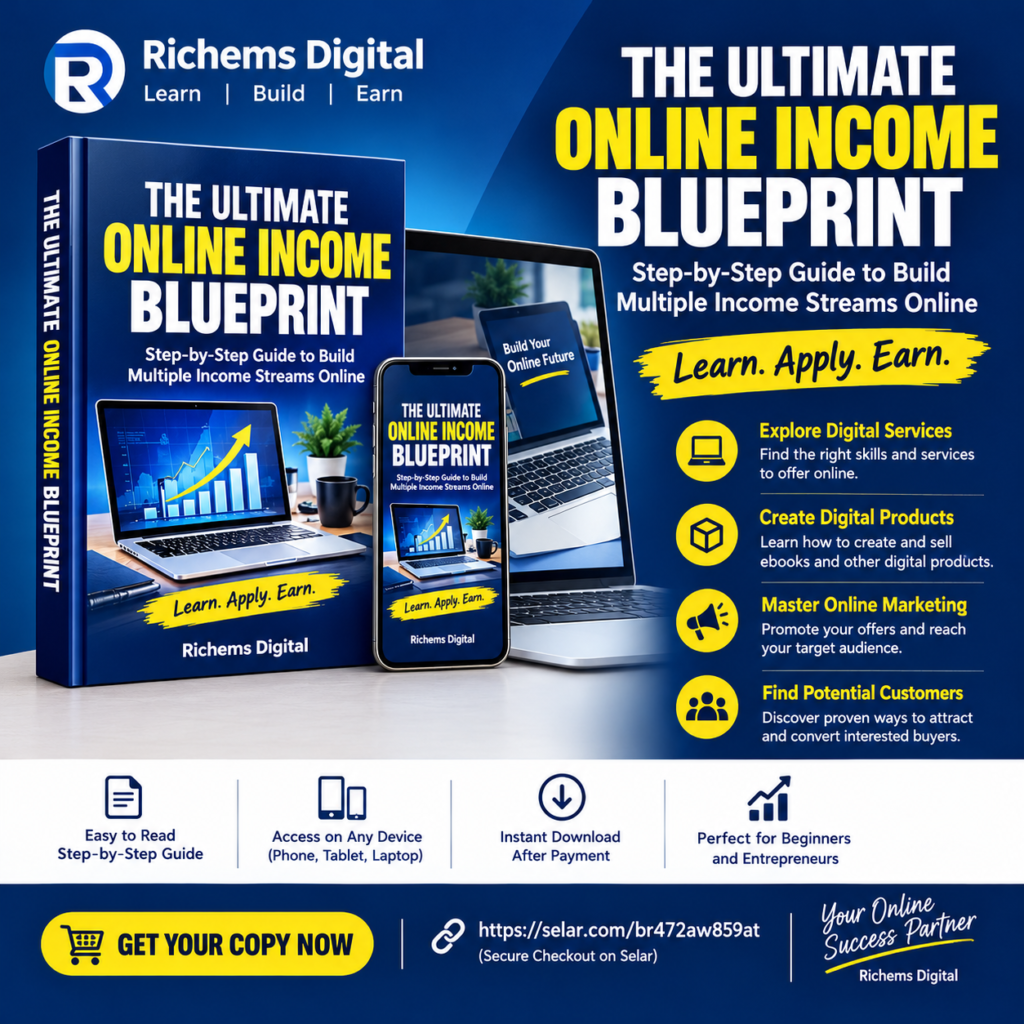
That is why Richems Digital offers THE ULTIMATE ONLINE INCOME BLUEPRINT.
What Is the Ultimate Online Income Blueprint?
THE ULTIMATE ONLINE INCOME BLUEPRINT is a practical guide designed to help readers explore ways to turn useful skills into income through digital services, products, and online platforms.
It is intended for people who want to understand online income opportunities and take a more organised approach to building a digital business.
Rather than treating online income as a mystery, the goal is to help readers approach it as a process of learning, creating value, identifying customers, and developing a suitable offer.
Who May Benefit From This Guide?
The guide may be relevant to:
- Beginners exploring online business opportunities.
- Aspiring freelancers.
- People interested in digital services.
- Individuals considering selling digital products.
- Small business owners exploring additional online channels.
- People who want to organise their approach to earning online.
The best results depend on how well the information matches your needs and how consistently you apply what you learn.
Why Consider a Structured Guide?
When you search for online income advice, you may encounter hundreds of articles, videos, and opinions.
The challenge is deciding what to learn first and how different activities fit together.
A structured guide can help you organise your learning and identify practical next steps.
However, purchasing a guide is only the beginning. You will still need to develop appropriate skills, research your target audience, practise, and take action.
No ebook can guarantee that you will earn a particular amount of money.
Get Your Copy
If you want a resource to help you explore digital services, digital products, and online business opportunities, you can learn more about the guide here.
THE ULTIMATE ONLINE INCOME BLUEPRINT
A practical, step-by-step guide to turning useful skills into income through digital services, products and online platforms.
Get the guide here:
“`htmlBefore purchasing, review the product page for the current price, description, and purchase details.
Take the time to choose an approach that suits your skills, circumstances, and goals.
14. Why Choose Richems Digital?
At Richems Digital, the focus is on practical digital solutions that help individuals and businesses establish a stronger online presence.
We understand that creating a professional digital presence involves more than putting information on a screen. It requires clear communication, thoughtful design, useful content, and an understanding of what visitors need.
Our services are designed to support a range of digital needs, including:
Website Design: Professional websites that present your business, services, or products clearly.
WordPress Design and Editing: Website creation, page editing, layout improvements, and assistance with common WordPress issues.
Landing Pages: Dedicated pages designed to explain a specific offer and guide visitors towards an action.
Logo Design: Visual identities that help businesses present themselves consistently.
Icon and Banner Design: Digital graphics for websites, promotional campaigns, and online communication.
T-shirt Design: Creative designs for personal projects, organisations, and businesses.
Digital Resources: Educational materials intended to help people understand digital business opportunities.
We aim to provide clear communication and solutions suited to each project’s requirements.
Whether you need help establishing a business website or want to learn more about digital products, Richems Digital is committed to making digital opportunities easier to understand and use.
Need Help With Your Digital Project?
If you need a professional website, WordPress assistance, landing page, logo, or promotional design, consider exploring our services.
Visit Richems Digital:
You can explore the website to learn more about our business and the digital services available.
15. Frequently Asked Questions About Making Money Online
1. Can I make money online without experience?
Yes, it is possible to begin an online business without previous professional experience, but you will need to learn and practise.
Start with a manageable skill or product, study the fundamentals, and create examples that demonstrate your ability.
Avoid accepting work that you are not equipped to deliver.
2. What is the best online business for beginners?
There is no single best online business for everyone.
Freelancing may suit someone who can provide a useful service. Digital products may suit someone who can create educational resources, templates, or other downloadable materials.
The best starting point depends on your skills, interests, resources, audience, and willingness to learn.
3. Can I start an online business with a smartphone?
Yes, some online business activities can be performed using a smartphone.
You can communicate with customers, manage social media, create certain types of graphics, publish content, and handle some digital product tasks.
However, complex website development, advanced design, and certain administrative tasks may be easier on a computer.
Choose a business model that matches the equipment available to you.
4. How long does it take to make money online?
There is no fixed timeline.
Some people may earn from a service after finding a suitable client, while others may spend considerable time learning, building a portfolio, and testing their offer.
Digital products also require time for development, promotion, and audience building.
Avoid relying on guaranteed-income timelines. Focus on actions that improve your ability to serve customers and generate legitimate sales.
5. Do I need a website to sell digital products?
Not necessarily.
You may be able to use a suitable digital product platform to publish and sell your products without building a separate website.
However, your own website can provide greater control over your brand, educational content, service information, and customer journey.
The right choice depends on your budget, technical skills, and business objectives.
6. Is selling ebooks profitable?
Selling ebooks can be profitable, but profitability depends on several factors.
These include product quality, customer demand, pricing, marketing costs, platform fees, refunds, and your ability to reach the right audience.
A well-designed ebook is not guaranteed to sell.
Research your market and develop a useful product before investing heavily in promotion.
7. How can I attract customers to my online business?
You can attract customers by creating useful content, building a professional online presence, sharing relevant examples of your work, networking, requesting referrals, and using appropriate advertising.
Focus on the channels your intended audience actually uses.
Measure meaningful results and improve your strategy over time.
8. Is online income guaranteed?
No.
Online businesses involve uncertainty, competition, expenses, and the possibility of making no sales.
Be cautious about anyone promising guaranteed earnings or effortless financial success.
Choose a legitimate business model, understand the risks, and make decisions based on your resources and circumstances.
9. Should I learn a skill or create an ebook first?
It depends on your existing knowledge and experience.
If you have a marketable skill, offering services may be a practical starting point.
If you already possess useful knowledge that can be organised into a reliable educational resource, you may consider creating a digital product.
In either case, research the audience and validate the offer before investing substantial resources.
10. What is the first step I should take today?
Choose one problem you want to solve for a specific audience.
Research that problem, identify a realistic solution, and determine what you need to learn or create to deliver it.
Then take one practical step, such as outlining a service, creating a sample project, or speaking to a potential customer.
Consistent action is more useful than endlessly searching for the perfect opportunity.
Conclusion: Start Small, Create Value, and Build Consistently
Making money online in 2026 involves more than finding a popular platform or following a trend.
It requires understanding people’s needs, developing useful skills, creating valuable products or services, and learning how to reach the right customers.
You can begin with website design, WordPress management, graphic design, content writing, freelancing, or digital product creation.
You can establish an online presence through a website, use social media to connect with potential customers, and publish educational content that demonstrates your knowledge.
You do not have to pursue every opportunity at once.
Choose a direction, develop the necessary skills, test your offer, and improve it based on customer feedback.
Remember that building a sustainable online business takes patience, effort, and responsible decision-making. Results are not guaranteed, but a structured approach can help you make better decisions and avoid common mistakes.
Your online business journey can begin with one skill, one useful solution, and one customer problem you are ready to solve.
At Richems Digital, we believe that practical digital knowledge and thoughtful implementation can help people and businesses make better use of online opportunities.
If you want to explore ways to turn useful skills into income through digital services, products, and online platforms, discover our guide.
THE ULTIMATE ONLINE INCOME BLUEPRINT
A practical, step-by-step guide to turning useful skills into income through digital services, products and online platforms.
Explore the guide and take your next step towards building your digital business.
Get your copy on Selar:
For website design, WordPress assistance, landing pages, and graphic design services, visit:
Learn. Create. Connect. Grow.
Richems Digital — Practical Digital Solutions for Your Business.